This online document is a means of sharing the adventure of traveling on America's waterways with friends and family. Last Dance is continuing to take her crew to historical, natural, beautiful, and interesting places. Enjoy the ride.

Thursday, November 8, 2018

Seneca Falls, NY, It's a Wonderful Life


The movie It's a Wonderful Life is set in Seneca Falls.  The movie was not filmed here, but the town was the vision in the writer's mind when he wrote the book.  Seneca Falls celebrates this heritage in many ways, including an It's a Wonderful Life Museum, pictured above.  Seneca Falls becomes the movie town of Bedford Falls as you step inside the museum, and in many spots as one walks the town.


The movie did not receive the best of reviews when it premiered Christmas Day, 1946, but it has become a Christmas classic, running on multiple TV networks every Christmas.  Seneca Falls bills itself as "The Real Bedford Falls" with an It's a Wonderful Life Festival every December.  A fun aspect of visiting Seneca Falls.


The second bridge in town, at the other end of downtown, has a history that was worked into the story as a major aspect.  In the early 1900's a person jumped off this bridge in an attempt to commit suicide.  Someone else jumped off the bridge to save them.  The rescue was successful, but the Good Samaritan died in the attempt.


Another storyline follows real life, although not a story from Seneca Falls.  Amando P. Giannini founded the Bank of Italy in San Francisco.  He often gave loans to people in need secured only with a handshake.  It was his example of caring about people that Frank Capra used to develop the character of George Bailey at the savings and loan in Bedford Falls.  The Bank of Italy was successful, very successful.  It grew into the Bank of America, much too large and impersonal to give a loan on a handshake.


Many aspects of the movie are documented in the museum, including George Bailey's suitcase which he planned to use on his venture around the world and the cigar cutter from the drug store where he worked as a youth.


Facts about the actors' lives after the movie were documented.  Few probably remember that Donna Reed became a leader in a movement to end war in campaigning for a Cabinet position of Secretary of Peace.

The child actors still are involved in the celebration of the movie, participating in the It's a Wonderful Life Festival every year.


As one walks through town there are constant reminders that you are in  Bedford Falls.  How's a deli fit that description, you ask?


The menu is dedicated to the characters and places in the movie.


The street that crosses that second bridge is known as Bedford Falls Blvd.


And, the cross street at the base of the bridge is George Bailey Lane.

It's a Wonderful Life integration into the fabric of the town gives a fun, nostalgic feel to Bedford Falls . . . oh, it's Seneca Falls.


Seneca Falls, New York


Seneca Falls is a small New York hamlet that grew up along the Seneca River, whose waters powered many factories and mills.  When the river was dammed and locks added, the water flow decreased to a point that it would no longer power machinery and the locations of the plants were flooded.  The decision had been made to use the waterways to provide transportation rather than power.  Seneca Falls remains as an interesting village, and although small, has so many interesting aspects that deserve multiple posts to share the various features, some quite important to our culture in the United States.

We will begin with the image of the church above.  The first feature of the hamlet (a specific governmental subdivision determined by population in New York) to be seen is this church along the Seneca River and Cayuga Canal.  This church, claimed to be the most photographed church in New York, gives a hint to the interesting architecture of buildings in the community.


Seneca Falls is a most welcoming community for cruising boaters.  They have a canal wall all along both sides of the river in the downtown area.  Power pedestals have been added and boats can be moored and have access to power at no charge.  A two-day limit is enforced to keep people from overusing this privilege.   The welcome center, which has a multiple story museum, also has a boaters lounge on the lower floor with showers and free washers and dryers.  The biggest concern of boaters who stop here is that two days is insufficient time to adequately view the features of Seneca Falls.  Fortunately, Last Dance passed through Seneca Falls twice, allowing two 2-day stays.  For perspective, the church in the first image is located just past the bridge in the background of this shot.


The main street of town parallels the river, located up two stories from the waterfront.  Old brick buildings line both sides of the street, most storefronts are occupied and the town is active.


One store features only products made by women.  This might seem odd to some, but once the history of Seneca Falls is understood, it is most appropriate to be located here.


A poster for sale in the Woman Made Products store.  Respect for all and equal rights is a theme throughout downtown Seneca Falls.


The unique geography of the Finger Lakes Region was displayed at the Seneca Falls Museum.  Part of the welcoming of this community is this three-story structure, with the first floor at waterfront level and the third floor at the main street level, serving boaters on the first level and all visitors on the second two levels.


One can enjoy and appreciate an area when the history is understood.  Seneca Falls makes the history lesson easy through many well-done displays.  This diorama depicted one time period of the hamlet.


For over 200 years, the manufacture of pumps has been a major industry here.  A wide variety of liquids require pumping to get them where they are desired.  From pumping water out of the ground for a single household use to pumping petroleum across the country.  Another education lesson made simple.


Another local manufacturer made wooden rules and measuring tools.  Since they were making rules out of thin pieces of wood, putting a few together allowed them to manufacture a popular home window treatment, the Ventian blind.


The dominant theme of Seneca Falls is equal rights, and in particular, Womens' Rights.  This, too, is on display at the city museum.  More details in another post.


The Seneca River was tamed through the construction of dams and locks, making for transportation via water as a part of the New York Canal System.  The Cayuga Canal connects Cayuga and Seneca Lakes to the Erie Canal and, therefore, to the rest of the world.  A major resource for industry in this area.  So, now there are no falls in Seneca Falls, but a peaceful, slow flowing canal used mainly by recreational boats.  Surprisingly, the Cayuga Canal is home to many Blue Herons, more than seen on most waterways.  They seem to take flight and lead the boat along the canal.  Some Bald Eagles were also spotted and Kingfishers seemed to be populated more densely than anywhere visited.  Their shrill cry always resonates as they fly along the canal.


Along the canal, between the two largest of the Finger Lakes, a familiar boat was spotted.  One that had been seen many times before.


Yes, it is the African Queen from the movie by the same name.  Humphrey Bogart and Katherine Hepburn had a great adventure on this boat, now moored behind a private home on the canal.  Or, did they?  Is this the real African Queen?  Or, is the one in the Florida Keys, described years earlier in the blog of Last Dance's first Loop, the real African Queen?

Link to the Florida Keys African Queen


Friday, October 12, 2018

Watkins Glen, NY - Watkins Glen State Park


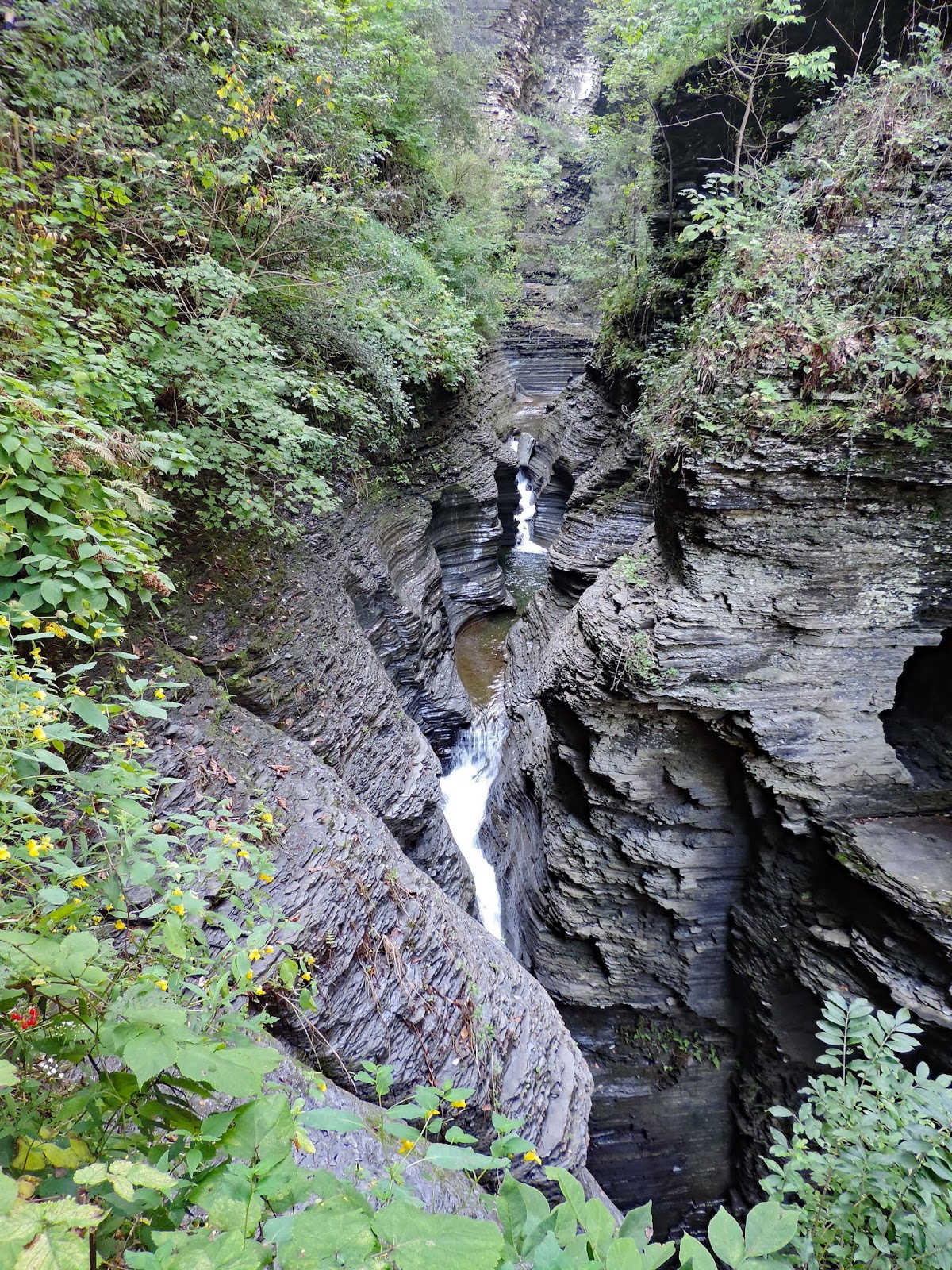
There is an amazing gorge, with multiple waterfalls and water features, which has become a New York State Park.  While Watkins Glen is famous for automobile racing, the gorge is what first brought people to the area.  They came not for the beauty but for the power created by the falling water.  The area was known as Jefferson, in honor of one the country's founders.  Sam Watkins came to the gorge and built flour and saw mills powered by the flow of the water.   After Watkins death, the community made a decision to change the name of the village to honor Watkins and the gorge, or valley, or glen, where his mill was located.


The Village of Watkins Glen formed at the mill and the county courthouse is just across the street from the new visitors' center.  The park is right in town.

As you enter the park, the rock gorge cut by the water can clearly be seen.


The beauty of the park made it ripe for tourists and resorts.  A resort was developed along the gorge, first opening in 1863, attracting visitors from around the world.  The State of New York acquired the land to become a state park, allowing all to walk the gorge and soak in its beauty.


A young woman, working at the park as a part of an Americorp project, had the duty of providing tours with detailed descriptions and history.  The morning of our hike up the gorge we had a private tour due to our lucky timing.  The walkways were all wooden during the resort days.  The stone walkways were built as part of a CCC project during the depression.  There are 19 waterfalls in the park and 800 steps along the trail. Here the walkway passes under a waterfall.


The waterfalls in Watkins Glen State Park are numerous, but they are not the only spectacular falls in this area of the state.  Less than 10 miles south of Watkins Glen is the even smaller village of Montour.  In a residential section of the village is the showy falls known as Shequaga.


We returned to Shequaga after a rainstorm and found the falls to be much more active.


The Watkins Glen State Park is most worthy of a visit and the surrounding area offer even more interesting sights.  And, did you know that the Finger Lakes region is known as wine country?


Watkins Glen, NY


Watkins Glen is a small New York village of less than 2000 people located at the south end of one of New York's Finger Lakes, Seneca Lake.  It is a small town, but a famous one known worldwide.  In 1948, Cameron Argetsinger wanted a place to road race his new MGTC and convinced the city leaders to close off the main street of town and surrounding roads to allow sports cars to race on a 6.6 mile circuit.  Argetsinger was successful and racing in Watkins Glen continues to this day . . . but not on public roads.


It is a long trip by slow boat to Watkins Glen.  One must head west on the Erie Canal, then south on the Cayuga Canal to the north end of Seneca Lake, then 37 miles south on the lake to Watkins Glen.  The biggest challenge for Last Dance was not the distance; it was fitting under the bridges.  A number of the bridges on Cayuga Canal are just 15' 6" above the water.  Last Dance is 15' 6" tall.  And, New York bridges do not have height gauges like the bridges along the Atlantic Intracoastal Waterway, so it is impossible to determine the actual height of the bridge with ever-changing water levels.


The Village of Watkins Glen celebrates its racing history every day.  Artful murals depicting the original races on the old street course adorn downtown buildings.


The downtown sidewalks are a walk of racing fame with the names of successful drivers in the Grand Prix races carved in granite.


All of the east-west streets are identified with a street sign in the shape of a cartoonish race car.  They love race cars in Watkins Glen.


Once a year the city hosts a huge festival to celebrate its racing history.  Over 30,000 people descend on this tiny village with 1000 cars on display and numerous activities in town.  In this image, an MGTC that raced in the 1948 inaugural event leads a group of race cars on the beginning of two laps around the old street course . . . at lower than race speeds.


The old course is much more challenging than it appears on a map of the track.  It has tight corners, blind corners, and many elevation changes.  There is over 500 feet of elevation change from the start-finish line in front of the courthouse to the stone bridge at the western end.  More elevation change in 3 miles than in the entire state of Florida.  The racers in 1948 were a courageous lot.


The same weekend as the festival also has vintage races at the Watkins Glen International Speedway, just a few miles outside the village.  Mini's were the featured car for this year's races.


Watkins Glen is also home to the International Racing Library which has the largest collection of books and documents on automobile racing.  The changing car display had the Maserati which lead the first lap of the first race in 1948 and the OSCA that won the last race on the street course in 1952.  Both beautifully restored cars.


Directly across from the courthouse, and in the center of the old street race course. lies Watkins Glen State Park, reason enough in itself to visit this area.  This beautiful gorge filled with waterfalls became an international tourist attraction in the late 19th century and it still lours visitors from around the world.  There is so much to share from a walk through this park for just a mention in a post about Watkins Glen, that it needs its own post.


Montuor Falls is a village less than 10 miles south of Watkins Glen, a village filled with waterfalls.  One is in an old section of town located between two houses.  Shequaga Falls is a spectacular scene.  The area around Watkins Glen is filled with drives that pass by waterfalls.


Few cruising boats make the long trip down Lake Seneca to Watkins Glen due to the low bridges, the long distance, the lack of natural coves for anchoring, or the lack of marinas for mooring.  Challenging in many ways, but a challenge, when met, provides many rewards and memories.

If the racing aspect of Watkins Glen interests you, there are some posts on the automobile blog which go into much more detail.  They may be accessed through the links below:

Grand Prix Festival

The Original Street Course

MG History at the Glen