This online document is a means of sharing the adventure of traveling on America's waterways with friends and family. Last Dance is continuing to take her crew to historical, natural, beautiful, and interesting places. Enjoy the ride.

Friday, November 9, 2018

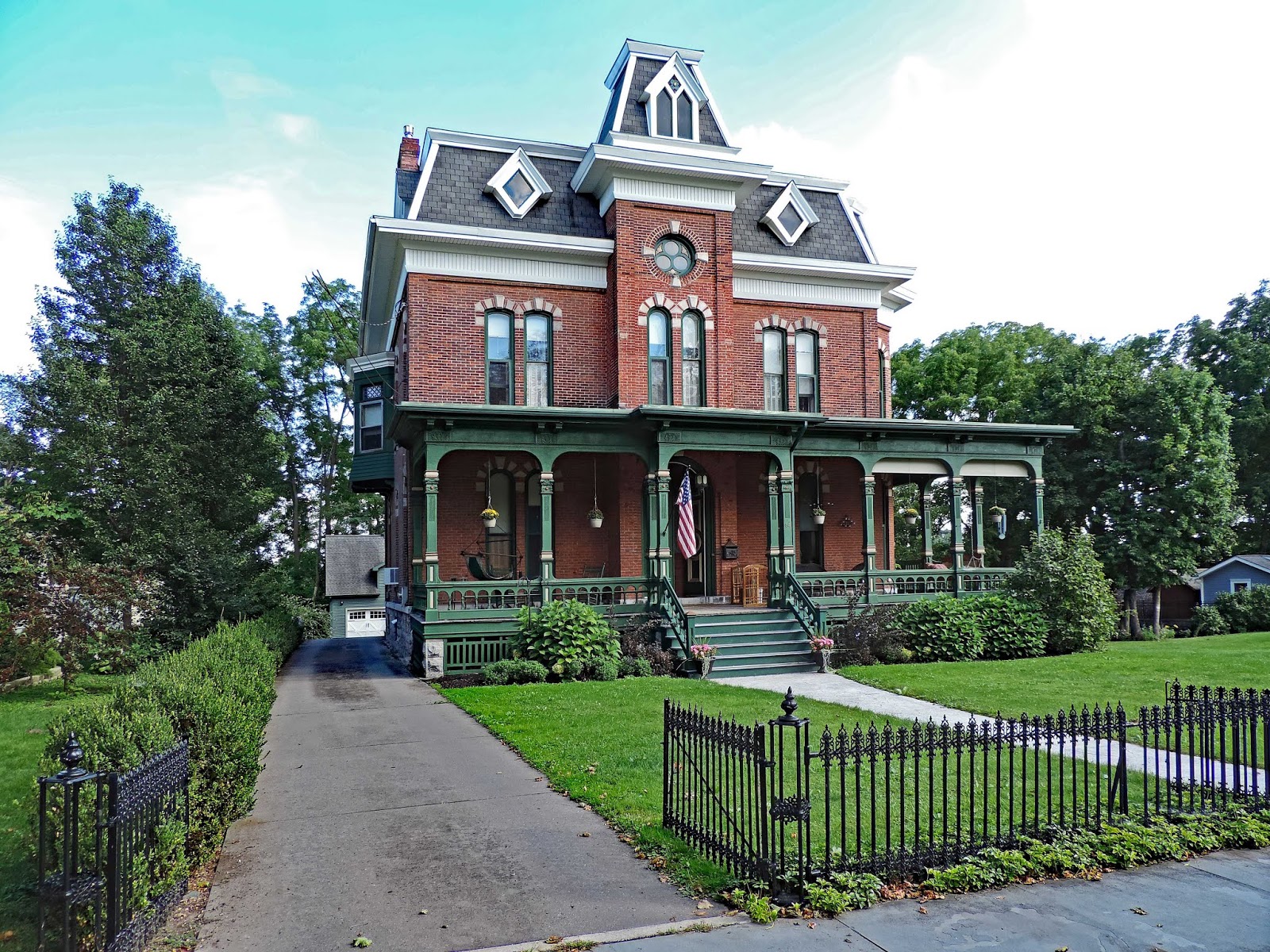
Seneca Falls, NY, Architecture


A stroll through old towns often turns into an architectural tour.  Seneca Falls realizes that their varied home architecture is an asset and produces a brochure identifying homes by architectural style and history.


If you find the architectural details contained in some of the older homes intriguing, take a walk through the hamlet of Seneca Falls through the images provided here.


This building was once a summer cottage, just a get-a-way from the big city life.  It is now utilized as an apartment building.


Many homes have yard art, often whimsical and comical.  This Seneca Falls home has yard art that might be described as whimsical, but it is a serious, well-done sculpture with a message.


For a town where the fight for women's rights began, a sculpture of a woman breaking out from her chains is most appropriate.


Behind a home sits an architecturally detailed carriage house where the horses needed for transportation were kept.


Seneca Falls, NY, National Women's Hall of Fame


The National Women's Hall of Fame is also in Seneca Falls.  It is hidden in plain sight in an old bank building right on the main street.  Nothing large or eye-catching grabs ones attention and it is easy to walk right past the Hall of Fame without recognizing what is in this building.  This situation is soon to change as the organization has purchased a large, old, long abandoned mill on the opposite side of the canal and is currently in the process of rehabbing the building to provide much greater space for exhibits.


CJS Architects Rendering of Rehabbed Knitting Mill Building


Most of the exhibits are biographies of Women honored as leaders in a specific area, some exhibits are more expanded in items presented.  In this display, a copy of the movie and a signed t-shirt commemorate the highly publicized tennis match between Hall of Fame member Billy Jean King and Bobby Riggs.  This public battle of the sexes was won by the female.  Another example was a set of clothing worn by Amelia Earhart on one of her flights.  The new, larger building will allow for more detailed displays.


A famous Floridian, Marjory Stoneman Douglas, the Champion of the Everglades, was an early inductee.  She has been in the news of recent, but not for her accomplishments.   Unfortunately, at the high school in South Florida named in her honor, there was a mass shooting.


Another Floridian honoree is Zora Neal Hurston, who has also been in recent news reports.  Her first book, Barracoon,  the story of a man who was aboard the last slave ship to reach American shores, was written in 1927, but was not published until 2018.  No publisher wanted to publish a book describing slavery for fear of retribution from the KKK and their sympathizers.  Her most famous book, Their Eyes Were Watching God, was choosen by a PBS show on reading as one of the top 50 books of all time.  Unfortunately, Hurston was not recognized for her work during her lifetime, dying penniless in 1960.


To follow on the Florida theme, Mary McCloud Bethune is another Florida honoree.  The school she began in Daytona Beach, now Bethune Cookman College, still serves a growing number of students and is a major economic force in the community.


Many women are recognized, from well-known to the obscure.  A few are shared here through images and a link to the listing of all honorees is at the end of the post.


List of All Women who have been Honored


Seneca Falls, NY, Women's Rights


The movement for Women's' Rights began in Seneca Falls in 1848, at a convention held in this chapel.  The chapel has been saved and renovated by the National Park Service to become part of a park documenting the history of the struggle for Women's Rights.


A new building has been constructed just west of the chapel to house the exhibit.  Leaders in the Women's Rights movement are depicted in a mural on the side of the park building.  Notable, one of the portraits is not of a woman, it is Fredrick Douglas.  Douglas is noted in history as an abolitionist, working to end slavery, but he is not thought of in terms of Women's Rights.  His participation in the Women's Rights Convention could be argued as the beginning of the Women's Suffrage movement.


In addition to documenting the first Women's Rights Convention and the early struggles, the National Park documents the continuing struggles through current times.


Women's Rights and Civil Rights have some overlap.  Sojourner Truth traveled the country bringing recognition to the ravages of slavery with a focus on the disrespect to Motherhood.  Most of her 13 children were taken from her to be sold to other slave owners.

Biography at National Park Service


Education in the U.S. for women and minorities was designed to erase their culture and keep them in their proper place, serving the privileged.


One of the exhibits is simply a window on the second floor overlooking the Wesleyan Chapel where the Women's Rights Convention was held.


Elizabeth Cady Stanton was one of the women who drafted the Declaration of Sentiments, the document outlining the demand for recognition.
When she was leading the discussion about the Declaration before the convention, most attendees argued that asking for the right to vote was too radical, that if it were included no man would recognize their requests as having any validity.  Frederick Douglas, the only African American in attendance, gave an impassioned plea that without a voice in selecting the representatives to government, their voices would never be heard.  He changed the minds of enough of the participants that the right to vote was left in the document.


The first link below leads to the speech given by Ernestine Rose at the convention to explain the Declaration of Sentiments to the participants.  The second link leads to the wording of the document itself which was signed by 100 of the attendees - 40 men and 60 women.

Declaration of Sentiments Speech

Declaration of Sentiments


Not all of the exhibits in the Park where of a serious nature.  There was some humor displayed in a manner to make the point.


To have a National Park dedicated to the 170-year struggle for Women's' Rights is a true privilege of living in the United States.  It also points out that 170 years has been insufficient time to accomplish the goals of equality.  This one of many reasons to visit Seneca Falls is sufficient reason alone to make the trip.  For more information on this National Park, click on the link below.

Women's Rights National Park


Thursday, November 8, 2018

Equal Rights on Display


This blog has been a photojournalistic record of interesting places along the Great Loop to share with family and friends.  Politics certainly has not been a focus.  And, it is a topic that is often avoided in group conversation, more so now than in the past.  We came face-to-face with the topic of equal rights on display at multiple stops on the summer 2018 journey, at museums along the waterway and at automobile museums on the drive south.  Those experiences call to be shared.

In the Gilmore Auto Museum, the cars are displayed with reference to the social times with fashion, important events, and period music playing.  Above, the display has a Buick, but the theme is the difficulty of travel by automobile in the United States during the Jim Crow era.


Throughout the US, the vast majority of gas stations, restaurants, and hotels would only serve white customers.  Often, the only opportunity that Black travelers had to get a meal or have a place to spend the night was in the home of another Black person.

To aide Black people traveling by car, Victor Green, a New York City mailman, began publishing a book that listed the few establishments serving Blacks.  When first published in 1936, it was titled as the Negro Motorist Green Book.  The Esso Corporation became a sponsor and sold it at some of their gas stations.  The main distribution was by mail order.


The places listed as a Tourist Home were not what a Bed and Breakfast is today.  It was a person's home where the owner would rent a couple of rooms to travelers, with no other option for overnight housing.


With Liberty and Justice for All


The Henry Ford Museum has an exhibit that focuses on the search for freedom for all.  The Revolutionary Era, the Antislavery Movement and Civil War Era, the Woman's Suffrage Movement, and the Civil Rights Movement each have an area with high-quality displays depicting important events including artifacts such as the chair in which President Lincoln was sitting when he was assassinated and the bus in which Rosa Parks was sitting when she was ordered to stand and let a white man take her seat.

The exhibit creates a feel for the struggles and difficulties people have endured to obtain basic human rights in the United States.


Lynching, the killing of a Black man or woman by hanging from the neck, was not considered a crime in America.  It was just a method to keep the "Negros in their 
place."  The practice of lynching occurred into the 1950's with no consequences for the perpetrators.  Lynching is just now (2018) getting discussion in Congress to become a Federal Crime.

The Jim Crow Guide to the U.S.A. details the extent of the laws and customs that kept the non-white races subservient. 


The Women's Rights displays documented the struggle, which began by women in Seneca Falls, NY, in 1848, as well as the Suffrage Movement and Equal Pay Issue.

For more information on the Freedom exhibit at the Henry Ford Museum, click on the link below.


Seneca Falls Women's Rights National Park


Tucked away in a small upstate New York village, the park celebrating the beginning of the Women's Rights Movement is rarely seen.  Thus, it holds a story that is little known among Americans. 

click here for National Park site

Interesting that a small village, an antique automobile museum, and a museum on American innovation all have exhibits on Americans struggling for basic human rights, a principle that is often lauded as the underpinning of the US Constitution.  It seems that the fight is still continuing for every American to truly have equal treatment under the law and from their community.


Reading List


The Jim Crow Guide, by Stetson Kennedy, was part of the display at the Henry Ford Museum.  Stetson lived in St. Augustine and the Last Dance crew was fortunate to know him as a friend.  The book is a satirical guide to Jim Crow laws and practices.  Kennedy wrote the book in the early 1950's, but no publisher in the United States would take on this topic.  It was published in France in 1956.  In 1990, the University of Florida Press finally published the book in the U.S.  Not long afterward, shots were fired through Stetson Kennedy's home, killing his dog.  The Sheriff Deputy who wrote the report on the shooting told Kennedy: "Sir, they weren't aiming for your dog."

Kennedy is best known for his efforts to expose the Klu Klux Klan.  One of his strategies was to share the Klan's secret passwords publicly through the scripts on the Superman radio show.  Materials he removed from a Klan waste basket provided the basis for the IRS to levy a large tax bill on the Klan. His book, The Klan Unmasked, details his activities with the Klan.


A more recent book (published 2012) details the story of the racial injustices perpetrated on Blacks in Florida in the case knows as the Groveland Boys - Devil in the Grove.  Four young Black men were falsely accused of rape in the central Florida town, Groveland, in 1949.  Gilbert King began research on Supreme Court Justice Thurgood Marshall for the basis of a book on the career of Marshall.  In his research, he found some letters written to Marshall when he was an NAACP lawyer.  The letters told of the terrible conditions for Blacks in Florida and of the injustices of law enforcement and the courts.  He found more than enough materials for a book on this one aspect of Marshall's career.  This book became the basis of a movement to pardon the Groveland Four, which was successful.  In January 2019, the young men finally received some amount of justice by being pardoned.`